Web
Design
Web
Design Web Development
 Apps
Development
Apps
Development Digital
Marketing
Digital
Marketing CMS
CMS Ecommerce
 Emerging Tech


 By: Rushik Shah
Your eCommerce store is bleeding money.
Not because your products are bad. Not because your team isn’t working hard.
But because you’re competing with machines.
While you manually write product descriptions, Amazon’s AI generates thousands. While you guess what customers want, Nike predicts it. While you answer support tickets one by one, Walmart’s chatbot handles hundreds simultaneously.
The gap is widening every day.
Here’s what the numbers actually show:
- Stores using AI see 20-40% conversion boosts
- Customer acquisition costs drop by 30-60%
- Support costs fall by up to 70%
- Average order values climb 10-18%
This isn’t about being trendy. It’s about survival.
Today, you’ll see exactly how real brands use AI to dominate their markets. We’ll cover everything: storefront optimization, marketing automation, customer experience, operations, and logistics.
No fluff. No theory. Just real examples you can learn from and use cases you can implement today.
What Problems Does AI Actually Solve?
Let’s be honest. Running an online store is harder than ever.
Rising customer acquisition costs eat your margins. Facebook ads that cost $10 per customer now cost $40. Google Ads keep getting more expensive. Your marketing budget feels like throwing money into a black hole.
Low conversion rates kill your revenue. Only 2-3% of visitors actually buy. The other 97%? They leave. They forget about you. They buy from someone else.
Search fatigue frustrates your customers. They type “blue dress” and get 847 results. They can’t find what they want. So they bounce.
Poor product discovery hides your best items. Your customers don’t know what they’re looking for. They need help. But you’re not there to guide them.
High return rates destroy profitability. Wrong sizes. Wrong colors. Products that don’t match expectations. Every return costs you money.
Manual inefficiencies slow everything down. Writing product descriptions takes hours. Updating inventory is tedious. Processing orders eats up your day.
Slow support makes customers angry. They wait hours for responses. Their questions pile up. Your small team can’t keep up.
No personalization makes you forgettable. Every customer sees the same homepage. The same recommendations. The same emails. It’s generic and boring.
Unoptimized pricing leaves money on the table. Should you discount that item? Raise the price? You’re guessing.
Fragmented data keeps you blind. Sales data lives in one place. Customer data in another. Marketing results somewhere else. You can’t see the full picture.
AI fixes all of this.
Not someday. Right now.
The Different Types of AI Powering eCommerce
Understanding AI helps you use it better. Think of AI as different tools in a toolbox. Each solves specific problems.
Predictive AI
This AI looks at patterns and predicts the future.
It forecasts which products will sell next month. It identifies customers likely to stop buying. It predicts inventory needs before you run out.
Business impact: You stock the right products at the right time. You prevent stockouts. You reduce excess inventory sitting in warehouses.
Generative AI
This AI creates new content from scratch.
It writes product descriptions. It generates ad copy. It creates product images. It builds email campaigns.
Business impact: You produce content 10x faster. Your small team does the work of 20 people. Content quality stays consistent.
NLP and Large Language Models
This AI understands and responds to human language.
It powers chatbots that sound human. It enables voice shopping. It makes search understand what customers actually mean, not just keywords.
Business impact: Customers get instant answers. Search works better. Support costs drop dramatically.
Computer Vision
This AI sees and analyzes images.
It enables visual search. It recommends clothing sizes. It checks product quality. It lets customers try on items virtually.
Business impact: Customers find products faster. Sizing issues decrease. Returns drop significantly.
Recommendation Systems
This AI learns what each customer likes.
It tracks behavior. It finds patterns. It suggests products customers actually want.
Business impact: More items per order. Higher revenue per customer. Better shopping experiences.
Automation AI
This AI handles repetitive operational tasks.
It manages inventory levels. It routes orders efficiently. It optimizes warehouse operations. It processes returns automatically.
Business impact: Lower operational costs. Fewer human errors. Faster order fulfillment.
16 Real-World Examples of AI in eCommerce
Now let’s see how actual brands use AI. These aren’t theories. They’re proven strategies making millions.
AI in Product Discovery
- Amazon – Personalized Product Recommendations
Amazon’s AI is legendary for a reason.
It uses collaborative filtering combined with deep learning. The system tracks what you view, what you buy, and what you skip. Then it predicts what you’ll want next.
Here’s the crazy part: This system drives roughly 35% of Amazon’s total revenue.
Think about that. One-third of the world’s largest online store comes from AI recommendations.
The use case: Every product page shows “customers who bought this also bought.” Every email includes personalized suggestions. Even the homepage changes based on your behavior.
You can implement this too. Start with basic recommendation engines. They learn from your data and improve over time.
- Sephora – AI Skin Analyzer
Sephora’s Color IQ uses computer vision to solve a real problem.
Matching foundation to skin tone is hard. Get it wrong, and customers return products. That costs money and creates frustration.
Their AI scans your face in-store or through your phone. It identifies your exact skin tone. Then it matches you with products that actually work.
The result: Fewer returns. Happier customers. More confident purchases.
The use case: If you sell anything where color, tone, or visual matching matters, computer vision helps. Beauty products. Paint. Fabrics. Even furniture.
- H&M – AI Demand Forecasting
H&M uses AI to predict fashion trends before they happen.
The system reads social media behavior. It analyzes sales patterns across regions. It spots emerging trends in real time.
Then H&M stocks products based on these predictions.
The result: Less overstock. Fewer markdowns. Better margins.
The use case: Demand forecasting works for any product category. The AI learns your sales patterns and predicts future demand. You order smarter. You waste less.
AI in Customer Experience
- Myntra – AI-Powered Virtual Try-On
Myntra lets customers try on clothes virtually using computer vision.
You upload your photo. The AI fits clothes onto your body. You see how items look before buying.
The impact: Customers spend more time browsing. They feel more confident buying. Purchase hesitation drops.
The use case: Virtual try-on works for fashion, eyewear, accessories, and furniture. Customers visualize products in their real life.
- Walmart – Conversational AI for Support
Walmart’s chatbot handles customer questions 24/7.
It answers order status questions. It helps with returns. It provides product information. And it never sleeps.
The system solves over 70% of queries without human help.
The impact: Support costs drop dramatically. Response times shrink from hours to seconds. Customer satisfaction actually improves.
The use case: Even small stores can use chatbots now. They handle common questions automatically. Your team focuses on complex issues.
- IKEA – Home Visualization Using AI
IKEA’s Place app uses augmented reality powered by AI.
You point your phone at your room. You select furniture. The AI places it in your space with accurate scale and lighting.
The result: Customers feel confident buying big-ticket items. They know furniture fits their space. Returns decrease.
The use case: If you sell anything for homes, vehicles, or physical spaces, visualization tools reduce buyer anxiety.
AI in Marketing
- Nike – Hyper-Personalized Campaigns
Nike’s AI predicts what each customer wants to see.
It analyzes browsing history, purchase patterns, and engagement data. Then it delivers personalized content across email, apps, and ads.
Someone interested in running gets running content. Basketball fans see basketball gear. It’s that simple.
The impact: Click-through rates double. Conversion rates climb. Marketing spend becomes more efficient.
The use case: Email segmentation and personalization increase revenue by 10-30%. Most email platforms now include AI features. Start there.
- eBay – AI Listing Creation
eBay sellers create millions of listings. Writing each one manually takes forever.
eBay’s AI generates product descriptions automatically. You upload a photo. The AI writes the title, description, and suggests categories.
The impact: Sellers list products 5x faster. Listing quality improves. More products reach buyers.
The use case: If you manage large product catalogs, AI content generation saves massive time. Tools like ChatGPT and Jasper help write descriptions in seconds.
- D2C Brands – AI Email and WhatsApp Automation
Indian D2C brands like Boat, Mamaearth, and Sugar use AI for automated customer journeys.
Abandoned cart flows trigger when someone doesn’t complete checkout. The AI sends a personalized reminder within an hour. Then another with a discount. Then a final urgency message.
Personalized recommendations arrive based on browsing behavior. If you looked at wireless earbuds, you get earbud recommendations.
Automated follow-ups happen after purchases. The AI asks for reviews. It suggests complementary products. It re-engages customers who haven’t bought recently.
The impact: 15-30% of abandoned carts convert. Repeat purchase rates climb. Revenue per customer increases.
The use case: Every store needs automated email flows. They work while you sleep. Tools like Klaviyo make this simple.
AI in Operations and Logistics
- Zara – AI Inventory Management
Zara uses RFID tags and AI to track every item in real time.
The system knows what’s selling fast. It predicts stockouts before they happen. It automatically triggers restocking.
The result: Popular items stay in stock. Slow items get marked down faster. Inventory turnover improves.
The use case: Inventory AI prevents stockouts and overstock. Both kill profitability. Even basic predictive inventory systems help small stores.
- Alibaba – Smart Warehousing
Alibaba’s warehouses use robots guided by AI.
The robots pick items. They pack orders. They move inventory around. Human workers supervise and handle exceptions.
The impact: Order accuracy reaches 99.9%. Labor costs drop. Order processing speeds up by 40%.
The use case: Full warehouse automation costs millions. But smaller AI tools help with order routing, picking optimization, and packing efficiency.
- UPS – AI Route Optimization
UPS uses AI called ORION to optimize delivery routes.
The system considers traffic patterns, delivery time windows, package sizes, and fuel efficiency. It calculates the best route for each driver.
The result: UPS saves millions of gallons of fuel yearly. Deliveries arrive faster. Costs drop significantly.
The use case: If you handle your own deliveries, route optimization tools save time and fuel. Even apps like Route4Me use AI to plan better routes.
AI in Fraud Detection and Security
- Shopify – AI Fraud Protect
Shopify analyzes billions of transactions to spot fraud patterns.
The AI checks buyer behavior. It flags suspicious orders. It considers device fingerprints, location mismatches, and velocity checks.
The impact: Chargebacks decrease by up to 40%. Legitimate orders don’t get falsely declined. Revenue protection improves.
The use case: Fraud costs eCommerce stores billions yearly. AI fraud detection is now affordable for all store sizes.
- PayPal – Machine Learning Fraud Prevention
PayPal’s AI achieves 98% accuracy in fraud detection.
It analyzes transaction patterns in milliseconds. It learns from billions of historical transactions. It adapts to new fraud tactics automatically.
The result: Customers trust PayPal. Merchants lose less money. The platform stays secure.
The use case: Using payment processors with built-in AI fraud protection is your first line of defense.
AI for Product Content and Visuals
- Amazon – AI Image Generation for Listings
Amazon now generates lifestyle product photos using AI.
You upload a basic product photo. The AI creates professional scenes. Your blender appears in a modern kitchen. Your backpack sits on a mountain trail.
The impact: Better images boost conversions by 20-40%. Professional photography costs thousands. AI costs pennies.
The use case: Tools like Midjourney and DALL-E create product lifestyle shots. You save money and speed up content creation.
- Wayfair – AI Home Decor Rendering
Wayfair shows how furniture looks in real rooms using AI.
The system places sofas, tables, and decor into room scenes. Lighting and perspective stay realistic.
The result: Customers visualize products better. Confidence increases. Return rates drop.
The use case: Visual rendering works for furniture, home decor, appliances, and even automotive parts.
Detailed AI Use Cases You Can Implement Today
Now let’s break down exactly how you can use AI in your store.
1. AI for Boosting Conversions
Smart Search: Traditional search matches keywords. AI search understands intent.
Someone types “party dress red.” AI knows they want red dresses suitable for parties. It filters by occasion, color, and style simultaneously.
Implementation: Platforms like Algolia and Klevu add AI search to any store. Setup takes days, not months.
Product Recommendations: Show products customers actually want.
Use “frequently bought together” on product pages. Add “recommended for you” sections. Send personalized product emails.
Implementation: Shopify has built-in recommendation tools. WooCommerce has plugins. Standalone tools like LimeSpot work with any platform.
Dynamic Pricing: Adjust prices based on demand, competition, and inventory levels.
AI monitors competitor pricing. It tracks your inventory levels. It adjusts prices to maximize profit or clear stock.
Implementation: Tools like Prisync and Competera automate dynamic pricing.
Personalization Engines: Show different homepages to different customers.
New visitors see best-sellers. Returning customers see items related to past purchases. Cart abandoners see what they left behind.
Implementation: Platforms like Dynamic Yield and Nosto add personalization without coding.
2. AI for Marketing
Automated Email Campaigns: Set up flows that run automatically.
Welcome series for new subscribers. Abandoned cart sequences. Post-purchase follow-ups. Re-engagement campaigns for inactive customers.
Implementation: Klaviyo and Mailchimp both include AI features. They suggest send times, subject lines, and content.
WhatsApp Sequences: Reach customers where they already chat.
Send order updates. Share abandoned cart reminders. Offer personalized deals.
Implementation: Tools like WATI and Interakt enable automated WhatsApp marketing.
Ad Creative Generation: Stop struggling with ad images and copy.
AI generates multiple ad variations. You test them. The AI learns which performs best.
Implementation: Meta’s AI tools create ad variations automatically. Third-party tools like Pencil do even more.
AI Copywriting: Write product descriptions, email copy, and ad text faster.
Describe your product briefly. The AI expands it into full copy. Edit as needed.
Implementation: ChatGPT, Jasper, and Copy.ai all write eCommerce content. They’re cheap and fast.
Audience Clustering: Group customers by behavior, not just demographics.
AI identifies clusters: “frequent buyers,” “discount seekers,” “high-value customers,” “browsers who rarely buy.”
Target each group differently.
Implementation: Most email platforms include segmentation. Tools like Segment and Klaviyo make clustering simple.
3. AI for Customer Support
Chatbots: Answer common questions instantly.
“Where’s my order?” “What’s your return policy?” “Do you ship to Canada?”
The bot handles these. Humans handle complex issues.
Implementation: Tidio, Drift, and Zendesk all offer AI chatbots. Setup takes hours.
Voicebots: Some customers prefer calling.
AI voicebots answer calls. They understand natural speech. They route complex calls to humans.
Implementation: Tools like PolyAI and Replicant handle voice support.
Multilingual Customer Support: Serve global customers without hiring multilingual staff.
AI translates conversations in real time. Your English-speaking support team helps Spanish, French, and German customers.
Implementation: ChatGPT API and Google Translate API integrate into support systems.
4. AI for Operations
Order Routing: Send orders to the nearest warehouse automatically.
A customer in Texas orders. The AI routes it to your Dallas warehouse, not New York. Shipping is faster and cheaper.
Implementation: Shopify Plus and ShipBob include smart order routing.
Warehouse Automation: AI helps even if you don’t have robots.
It suggests optimal picking paths. It prioritizes urgent orders. It predicts which items to move closer to packing stations.
Implementation: Warehouse management systems like Fishbowl and ShipHero include AI features.
Return Predictions: Identify which orders are likely to return.
The AI analyzes patterns. First-time buyer ordering 5 items in different sizes? High return risk.
You can flag these for quality checks or send sizing guidance proactively.
Implementation: Tools like Narvar and Loop Returns use AI to predict and reduce returns.
5. AI for Product Content
Auto Product Images: Generate lifestyle photos without photoshoots.
You have a plain product photo. AI creates it in a kitchen, office, or outdoor setting.
Implementation: Tools like PhotoRoom and Pebblely generate backgrounds. DALL-E and Midjourney create full scenes.
Auto Product Descriptions: Write hundreds of descriptions in minutes.
Feed the AI basic product specs. It writes engaging descriptions optimized for search and conversions.
Implementation: ChatGPT works great. Jasper and Copy.ai specialize in eCommerce copy.
Auto SEO Content: Generate category pages, buying guides, and blog posts.
AI writes SEO-optimized content that brings organic traffic. You edit and publish.
Implementation: SurferSEO and Clearscope combine AI writing with SEO optimization.
Real Benefits with Measurable Results
AI isn’t magic. But the results are impressive.
Conversion Rate Improvements: 20-40% Personalization and better product discovery convert more visitors into buyers.
Cost Reduction: 30-60% Automation cuts labor costs in support, content creation, and operations.
Faster Delivery: 15-30% Improvement Smart logistics and routing speed up fulfillment.
Return Reduction: 12-22% Better size recommendations and product visualization reduce returns.
Higher Average Order Value: 10-18% Smart recommendations encourage customers to buy more items.
These aren’t promises. They’re documented results from real companies.
Your results depend on implementation quality and your starting point. But the potential is real.
How to Actually Adopt AI in Your Business
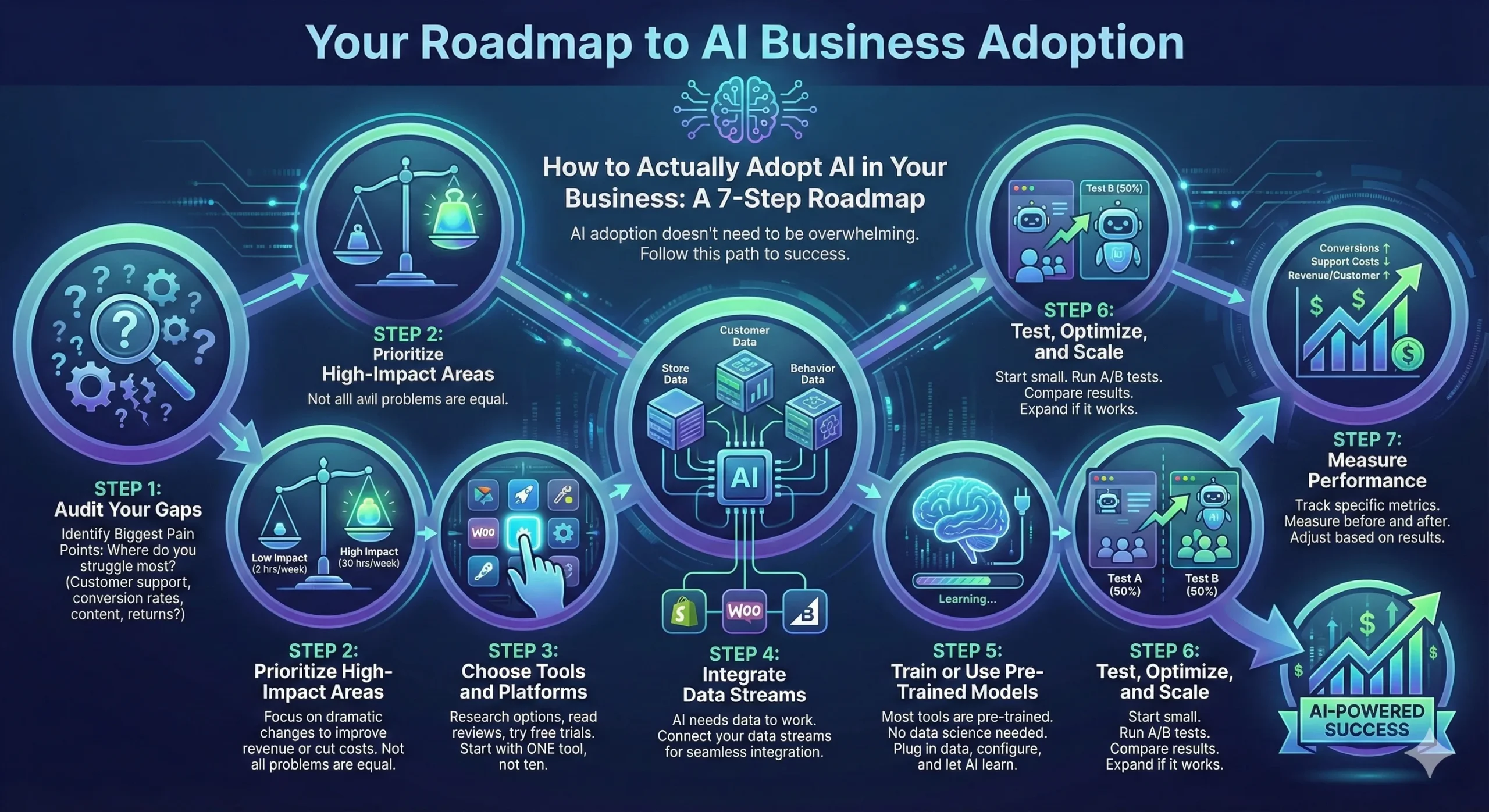
AI adoption doesn’t need to be overwhelming. Follow this roadmap.
Step 1: Audit Your Gaps Where do you struggle most?
Is it customer support eating up time? Poor conversion rates? Slow content creation? High return rates?
Identify your biggest pain points first.
Step 2: Prioritize High-Impact Areas Not all problems matter equally.
If support takes 2 hours weekly, automating it saves minimal time. If it takes 30 hours weekly, that’s your priority.
Focus on changes that dramatically improve revenue or cut costs.
Step 3: Choose Tools and Platforms Research options for your priority area.
Read reviews. Try free trials. Start with one tool, not ten.
Step 4: Integrate Data Streams AI needs data to work.
Connect your store data, customer data, and behavior data. Most tools integrate with major platforms like Shopify, WooCommerce, and BigCommerce.
Step 5: Train or Use Pre-Trained Models Most AI tools come pre-trained.
You don’t need to be a data scientist. You plug in your data and configure settings. The AI learns from there.
Step 6: Test, Optimize, and Scale Start small. Run tests.
Try AI chatbots on 50% of visitors. Compare results. If it works, expand to 100%.
Step 7: Measure Performance Track specific metrics.
Did conversions increase? Did support costs drop? Did revenue per customer improve?
Measure before and after. Adjust based on results.
Recommended AI Tools for eCommerce
Here are practical tools worth exploring. These aren’t sponsored recommendations. They’re widely used and reliable.
| Category | Tool | Use / Purpose |
|
Marketing AI Tools
|
Klaviyo | Email + SMS automation, AI segmentation, send-time optimization |
| Mailmodo | Interactive email campaigns with AI personalization | |
| Brevity | AI-generated marketing copy | |
| ChatGPT | Product descriptions, content writing, customer service replies | |
| Jasper | AI copywriting for ads + product pages | |
|
Retail & Product AI
|
Vue.ai | Product recommendations + visual search |
| Syte | Visual search + product discovery | |
| Fashwell | Computer vision for fashion retail | |
|
Logistics AI
|
ShipBob | Fulfillment + AI inventory management |
| Flexport | Supply chain + logistics optimization | |
|
Customer Support AI
|
Freshchat | AI chatbots + live chat fallback |
| Zowie | Automated customer service for eCommerce | |
| Gorgias | Helpdesk with AI reply suggestions | |
|
Content Creation AI
|
ChatGPT | Content + ideas + product descriptions |
| Copy.ai | Marketing copy and product text | |
| Midjourney / DALL-E | AI image generation | |
| PhotoRoom | Product photos + background removal |
Start with free versions. Test thoroughly. Scale what works.
Challenges and Limitations of AI
AI isn’t perfect. Know the limitations before diving in.
Data Privacy Concerns: AI requires customer data to work.
You must comply with GDPR, CCPA, and other privacy laws. Customers worry about how you use their data.
Solution: Be transparent. Clearly explain data usage. Give customers control over their data. Use secure, compliant platforms.
Over-Automation: Automating everything removes the human touch.
Some customers want human interaction. Complex issues need human judgment. Over-automation frustrates people.
Solution: Use AI for routine tasks. Keep humans available for complex situations. Let customers choose between bot and human support.
Poor Training Data: AI quality depends on data quality.
Small stores with limited data get limited results. Biased data creates biased AI.
Solution: Start with pre-trained AI tools. They learn from millions of businesses. Add your data gradually to improve performance.
Integration Challenges: Connecting AI tools to your existing systems can be tricky.
Legacy systems might not connect easily. Custom builds get expensive.
Solution: Choose tools that integrate with your platform. Shopify, WooCommerce, and BigCommerce have extensive app ecosystems. Most AI tools support these platforms.
Cost of Implementation: Enterprise AI costs thousands monthly.
Custom AI development costs tens or hundreds of thousands.
Solution: Start with affordable SaaS tools. Most cost $50-500 monthly. Scale investment as revenue grows. ROI usually justifies costs quickly.
The Future of AI in eCommerce
AI is evolving fast. Here’s what’s coming.
AI-Generated Stores: Entire store designs created by AI.
You describe your brand. AI generates layouts, color schemes, and content. Store setup takes hours instead of weeks.
Autonomous Fulfillment: Warehouses run by robots with minimal human oversight.
Orders get picked, packed, and shipped automatically. Humans handle exceptions only.
AI-Driven Pricing Wars: Prices adjust in real time based on competitor moves.
Algorithms compete against algorithms. Prices fluctuate constantly to capture demand.
AI Buying Agents: Consumers use AI assistants to shop for them.
“Buy me running shoes under $100 with good arch support.” The AI shops across stores and buys the best option.
Zero-Click Shopping: AI predicts what you need and orders it automatically.
Your coffee subscription reorders before you run out. Your preferred products arrive without you clicking buy.
Emotional AI for Support: AI detects customer emotions through text and voice.
Frustrated customers get routed to senior support. Happy customers get upsell opportunities.
Voice Commerce Dominance: Shopping through smart speakers becomes mainstream.
“Alexa, reorder my laundry detergent.” “Hey Google, find me a birthday gift for my sister.”
These aren’t decades away. Many are happening now.
Early adoption gives you competitive advantage. Wait too long, and you’ll struggle to catch up.
Your Next Move
AI has moved from future tech to present reality.
Stores using AI grow faster. They serve customers better. They operate more efficiently. They spend marketing budgets smarter.
The brands dominating your market? They’re already using AI.
Amazon, Nike, Walmart, Sephora—they didn’t wait. They invested early. Now they’re pulling further ahead every day.
But here’s the good news: AI tools are now affordable for small businesses.
You don’t need a team of data scientists. You don’t need a million-dollar budget. You need the right strategy and the right tools.
Start with one use case. Maybe it’s email automation. Maybe it’s a chatbot. Maybe it’s product recommendations.
Test it. Measure results. Then add more.
The gap between AI-powered stores and traditional stores is growing. But you can still catch up.
The question isn’t whether you’ll use AI. It’s when.
Ready to Transform Your eCommerce Business with AI?
At Alakmalak Technologies, we help eCommerce businesses implement AI automation that actually drives results.
We don’t just talk about AI. We build custom solutions for:
- AI-powered chatbots that handle customer support 24/7
- Personalization engines that increase conversions by 30%+
- Automated marketing systems that nurture customers without manual work
- Smart inventory management that prevents stockouts and overstock
- AI content generation that creates product descriptions and images at scale
Our team has implemented AI solutions for eCommerce stores ranging from startups to established brands.
We understand both the technology and the business. We build systems that integrate seamlessly with your existing platform. And we measure ROI, not just features.
Ready to see what AI can do for your store?
Contact Alakmalak Technologies today for a free consultation. Let’s discuss your biggest challenges and show you exactly how AI solves them.
Don’t let your competitors leave you behind. Start your AI transformation now.
Let’s build the future of your eCommerce business together.